Saturday, 18 February 2017

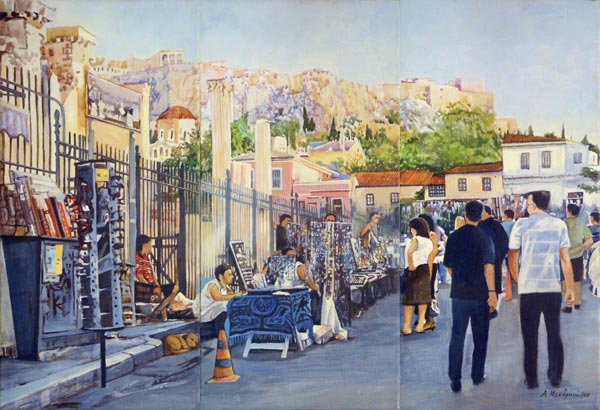
Anna Mendrinou Greek Artist - by Patrick Brigham


2007-monastiraki-3fold

Anna Mendrinou was born in Athens. In 1964 she started studying Printmaking at the Athens School of Fine Arts. At the same school she studied Typography and Book Art with a scholarship. In 1968, she graduates from the Printmaking workshop with three honorary distinctions and in 1969 she graduates from workshop of Book Art.

Anna Mendrinou

Anna Mendrinou has illustrated about 140 books, has been awarded 4 Panhellenic Prizes and has been included in the IBBY Honour List. In 1987 she was nominated for the International Anderson Award.


Since 1980 she has been working at the Goulandri Museum of Natural History. Anna Mendrinou is a member of the Greek Chamber of Fine Arts and one of the founding members of the Greek Engravers Association. She is also a member of the “Aesop” Company of Illustrators.


As a printmaker and an illustrator, Anna Mendrinou has participated in many exhibitions in Greece and abroad. In 2002 she was awarded the 1st National Award for Children’s Book Illustration for the book “Aesop’s Fables”


Property in The Balkans - by Patrick Brigham


COMMERCIAL PROPERTY-

GREECE-

Overall, commercial property in Greece is hardly going to set the world alight. Due to the prevailing economic climate and to austerity measures, most high streets look like a smile with teeth missing, due to the number of dead windows and empty shops. Shopping, which was once one of Greece’s greatest pleasure’s, has been reduced to necessities, rather than luxury goods. Other than Athens and Thessaloniki – where tourists are most likely to be – and unless in a primary location, it is the same story everywhere, especially with unoccupied shops and offices in the secondary areas.

What movement there is, is mainly about existing business repositioning itself, or moving from older buildings into new. Rents are also a factor, because Greek property owning companies and individuals, are now faced with heavy taxes. Most property is hard to either sell or let, and consequently rents have been virtually halved. Whilst owners have been faced with recession, and facing the fact of a declining revenue, the inevitable choices have had to be made.

BULGARIA-


Whereas, the residential market in Bulgaria is fairly well managed and defined, commercial property has revealed certain problems of ownership, especially with one particular UK deal. According to the FT-

“The problems of East Balkan Properties, a UK-based property company, underscore the risks associated with investing in a poorly regulated property market, where there are doubts about judicial independence.”

Up until February, Glorient Investment Bulgaria, a local subsidiary of East Balkan Properties – which specialises in building retail premises – was receiving regular income from 22 outlets of Technomarket, a Bulgarian electrical goods retailer, from which it bought the properties some 10 years ago.

Allegedly, NSN Investment – a company that acquired Technomarket early this year – is taking legal proceeding against Glorient, claiming its deal with the Technomart is invalid, that the properties still belong to Technomarket, and consequently rents on the retail outlets have not been paid since the dispute began.

“We’re extremely worried about this breach of property rights in an EU member state,” says Michael Uhler, East Balkan managing director, and Glorient is contesting NSN’s claims in court in Bulgaria.”


New Development Sofia

I haven’t been in the property market in Sofia for some years now, but what is certain, is that some local entrepreneurs are renowned for their non observance of EU business protocols, a cast occasionally populated by members of the Mutri, and many other unethical people besides. Mainly due to a penchant for silly games, and a track record for fraud, the Sofia ‘bloody foreigner syndrome,’ seems to remain intact, even to this day.

According to local pundits, the world of commercial property is changing, in Sofia, and retail business's are now returning to the high street. Away from the retail shopping malls - many of which are in secondary positions - popular names can now be seen once more in pedestrianized, Vitosha Street, and the many City centre offshoots. Once regarded as one of the most expensive districts in Sofia, out of town retail, has at least helped city centre rental values to achieve an acceptable level.

In the office sector, since most of the major international commercial players are now present in Sofia, there has been an an oversupply of office space, and letting offices on the outskirts of the city has always been a destination of last resort. Many western property developers have come into the Sofia marketplace since the changes in 1990, because much of the office space was badly planned and not sufficiently ergonomic

RESIDENTIAL INVESTMENT IN THE BALKANS

Despite the financial turmoil of the last nine years, many ex-pats who came to the Balkans early on are now well established. Consequently, there are a number of modernized and renovated residential properties for sale, mostly at reasonable prices, all available locally often with an implied British mark of quality, and this is particularly true of Bulgaria. Because labour costs have also been reduced due to unemployment, so the cost of building a house has also decreased, and there are many willing builders – throughout the Balkan area – able to work at reasonable prices.

This includes a small number of English and Irish contractors who have in the last few years, become experienced in the ways of the Balkan peoples. These ex-pat builders are not only a phone call away, but can be found on Facebook, Twitter and LinkedIn, together with abundant evidence of their high-quality standards of construction.

In turn, many ex-pats have also moved on up the property ladder, meaning that there are additional solid and comfortable homes on the market, needing little or no alteration or renovation. Occasionally sold together with fixtures, fittings and also furniture, they represent an ideal investment – or holiday retreat – for a discerning buyer in need of quality accommodation, but, without the hassle of setting up a brand new home themselves

We are now entering a new phase in South Eastern Europe and with the financial meltdown of 2008 apparently behind us, we are fast approaching a new era of stability. This means that, although Balkan property prices have never been cheaper in Bulgaria, Greece or even Turkey, they will not remain that way for much longer!

Because of the current prices on offer, houses and apartments have now become far more accessible to many, and well within the scope of Europeans looking for a home abroad. Perfect for young families and retired couples alike – and those who simply want to relax in the sun – the Balkan way of life can certainly take the stress out of living. Whether only for the summer months – but occasionally forever – the Balkan region promises a recipe for a long and healthy life; particularly in the rural areas.

Like most farming communities the local inhabitants are rarely under pressure, but they are governed by the seasons and of course the weather. Baking hot summers will soon cause any visitor to take a snooze in the afternoon – when the sun is so hot – that even ‘mad dogs and Englishmen,’ are frightened to venture out. But, why is it easy?

GREECE-


Modern Bungalow Northern Greece

Winters are generally mild, although this year was an exception, all over the Balkans, where snow tires came highly recommended. As an early member of the EU, Greece has enjoyed ongoing investment in transport and communication, and Evros, where I now live, is no exception. The roads are all generally good, although Greek drivers do tend to hug the middle of the road. They say it is because there are rocks rolling down the mountains and hills, even though there is little evidence of a mountain or hill locally, as far as one can see! Greece is also full of airports and people are often spoilt for a point of departure and also for their final destination!

The North of Greece is peaceful and safe, and populated by people who define their own existence as easy. Most experienced travellers have visited Greece at one time or another, but few know anything about the very north of Greece, Evros, or its history. Due to its prominence, Greece has about 144,000 expats living there, particularly on the islands, and – due to deflated housing prices – all over Thrace or East & West Macedonia. Only slightly more expensive than Bulgaria, property in northern Greece comes with just a tad more civilization.

BULGARIA AND THE SOUTH EAST


Renovated House in South East Bulgaria

Bulgaria was a Communist country until 1990 and so many facets of civil life can be a little over the top. Much of the infamous bureaucracy has been diluted, as have the many laws concerning foreigners, which over time had become pointless, and out of step with the rest of Europe. These days an EU citizen can buy a house or a car, without owning a Bulgarian company, the only restriction being that you have to have an Internal Residents Permit.

When Bulgaria went from a command economy to a country generally supporting private enterprise, many Bulgarian citizens became confused, and years spent as the victims of primitive propaganda, made the average Bulgarian a trifle Xenophobic. Twenty years on and the children and grandchildren of Communism are trying to put the past well and truly behind them. The new face of Bulgaria may seem a little careworn at times, but the instinct for survival remains intact, within a country where hard work is a necessity. But, beware of indigenous builders!

Short of skilled craftsmen and women, Bulgaria has recently recognized the need for more artisans, amongst a plethora of MBA’s. What is really good, however, is the high standard of IT professionals, which is why Bulgaria enjoys a modern level of communication – subject of course to occasional power cuts!

Some 9000 ex-pat immigrants from EU countries live in Bulgaria, with many in and around Varna, Burgas, and Haskovo. This is an area of great natural beauty and depending on your needs, offers both sea views and long country walks. Elhovo in the Yambol Region is a favourite place for some Brits, who by getting together, have established quite a community. The Black Sea, Varna and Burgas, are more popular for holiday homes, with some permanent ex-pat residents also there, and surprisingly, a number of UK food shops.


New Build Small Apartments in Bansko

In the skiing areas of Bansko, Pamporovo and Vitosha, asking prices have been greatly reduced for studio and small apartments, the somewhat empty investment promises – of countless owners and estate agents – coming to nothing. Having said that, now the short stay and cheap flight option has recently emerged, Bulgarian ski resorts generally, and the short let market, might find new vigour once more.

Throw Me a Bone - by Patrick Brigham


Old Mother Hubbard

Went to the cupboard,

To give the poor dog a bone;

When she came there,

The cupboard was bare,

And so the poor dog had none.


This is not a fairy tale, but a realistic account of Donald Trumps ascent into power, and the frightening consequences which might affect us all, which are beginning to appear on the horizon. To believe that President Trump is a tough guy, is a matter for conjecture, but what is certainly true is that he is not taken very seriously by many powerful world leaders, and – at the present moment – is currently being tested on his acumen, resilience, wisdom and foresight.

Demonstrated by the launching of an intermediate missile by North Korea, during the visit of Shinzō Abe the Japanese Prime Minister to the White House, from the blatant provocation, and the intended humiliation, it was clear to see that this tough guy stance was not being taken very seriously.

The lukewarm visit of Prime Minister Trudeau of Canada did not help much – to bolster Trumps constant image building – and in fact Trudeau’s statement that Canada had no right to criticize or condone the present US immigration policy, did precisely the opposite. In a beautifully timed reply to a journalist – during question time at the press conference – Canada’s attitude to the American Presidents Islamophobia, was made very clear.

Not only that, but his misogynistic views, and ‘good old boy’ attitude towards women, has even inspired John Bercow – the commons Speaker in the UK Houses of Parliament – to put a ban on Trump addressing the commons.


So, is Donald Trump a maverick, Mystic Meg, or just a loud mouthed fool? How is it that almost everyone in his cabinet seems to have a skeleton or two in their respective cupboards, and how was it that – prior to official appointment – his new head of intelligence, did such an unintelligent thing, and chatted over an open line to the Russian ambassador to Washington?

America has its own culture, and political culture, which it attempts to export all over the world. Always with a huge money content, many US companies are rarely far behind any government foray into other peoples countries or any regime change they might seek to provoke.

What people like Trump will never understand, is that might is not always right, and what we see in Europe today, is the expensive and damaging result of the Bush/ Blair attempt at the manipulation of the Middle East. In other words, the US dropped the bombs, and now Europe is in chaos, trying to tidy up the results.


And of course, while we are at it, let us consider the 2008 financial crisis – that most of us were affected by in one way or another – wasn’t it the Wall Street bankers who flooded the world with worthless paper, and the black hole in which to tip it?

All in all, it seems to me that we have very little to thank the US for in ‘modern’ Europe, other than as being a marketplace for expensive motor cars, and luxury goods, because the modern day tradeoff does seem to be a little one sided in my view. Although, this might also go directly back to the matter of culture, but with a small ‘c.’.

Americans rarely understand other peoples cultures, and wrongly assume that everyone either wants to be like them, or actually live in America. I can think of a long list of things I like about the US, but living there is not one of them.

Many of us can still remember how much the US did in Europe during the Second World War, and afterwards with the Marshall Plan. But then is then, and now is now. Trumps problem is that he may understand America – or how else did he get elected – but tinkering with other world powers will be his downfall, because, to the likes of Putin and China’s Xi Jinping, Donald Trump is currently no more than a TV personality.


This wonderful dog

Was Dame Hubbard’s delight,

He could read, he could dance,

He could sing, he could write;

She gave him rich dainties

Whenever he fed,

And erected this monument

When he was dead.

Friday, 10 February 2017

‘Angel in The Morning’- Yanka Rupkina by Patrick Brigham


As time and tide continue the remorseless erosion of our memories, and the prattle and tittle tattle of daily news, simply serves to prove how little has changed in Bulgaria – and probably never will – it is perhaps better to dwell on the past. Because, even during darker times, the music of the ‘Trio Bulgarka’ was a beacon of hope, in an otherwise drab and remorseless life under Communism.

Bulgaria has always been about the cities versus the provinces, and whilst there was little to offer by way of consumer distractions, there was music, singing and dancing. If there was nothing else, then there were at least some authentic memories from the past, reminders of better times, and of a rich cultural Bulgarian heritage.

And one perfect voice was to disprove the mediocrity and mendacity of communism, to rise above the dumbed down and second rate. This was at a time when the sound of the Stranja Mountains found its way into the modern world of music, with the unique voice of Yanka Rupkina.

Yanka Rupkina says – “I started singing when I was a child. I took part in various singing contests at different stages in our region and this was so until I appeared at the folklore fair at Gramatikovo in 1960 and won the first prize. The jury was lined up with folklorist Boris Petrov, from the Bulgarian National Radio and Mihail Bukureshtliev who invited me to make an audition in Sofia. Among 400 singers from the whole of Bulgaria, I was selected for soloist of the ensemble for folk songs of the Bulgarian National Radio. With it, I made many recordings and I appeared on various stages. Also, apart from this group, I was touring the world with The Balgarka Trio. These were years of world recognition and triumph of the Bulgarian folk song in the world’s grandest halls.”

Radio disc jockey John Peel, was one of the first people to really appreciate Yanka’s voice , when the Trio Bulgarka – known as ‘The Three Golden Coins,’ gained Balkan prominence, through their 1975 world music album called Bulkana: The Music of Bulgaria, and more-so on their 1988 album, ‘The Forest is Crying.’

But it was Kate Bush, who really put the trio, and especially Yanka, into the limelight. When the trio was featured on the 1989 Jo Boyd album ‘Sensual World’ – which incidentally featured Prince – it seemed that the stifling communist past, had reluctantly freed Yanka Rupkina into the real world.

Kate Bush

Yanka Rupkina says – “Producer Joe Boyd had followed my singing career, listened to me at the Koprivshtitsa Folk Festival and decided to invite me for some joint projects. It was he who described the Bulgarian folk songs as a phenomenon in music. We toured the world with the Balkana Band, which included some of the best folk music instrumentalists from the BNR Folk Band. For me an unforgettable moment was our concert at the Royal Festival Hall, in London, when George Harrison arrived with friends from California. This was a most emotional encounter – one of the Beatles had come to listen to me – and to our Bulgarian folk songs.”

Sounds from The Stranja Mountains

“I’ve never worked with a woman on such an intense creative level,” Bush told the Los Angeles Times, in December 1991, “because, it was strange to feel this very strong female energy in the studio. It was interesting to see the way the men in the studio reacted too, because instead of just one female, there was a very strong female presence.”

Composer Robert de Groot

This is the point when film composer Robert Jelmer De Groot arrived on the scene. Famous for his score for the film ‘The Seven Samurai,’ he too became fascinated by the voice of Yanka Rupkina, and the melancholy sound of the Stranja Mountains. He spent some time in Sofia, from 1997 onwards, composing and recording at the National Bulgarian Recording Studios. He explained that despite the dated equipment, they produced a warm pink sound, and were very good at production, with good studio musicians and engineers. Perhaps, at times, we all forget what Bulgaria is good at, and the latent talent kept hidden away in the wings.

Video of The Seven Samurai & Karanka by Yanka Rupkina

This was also when I moved into the picture. Robert had an idea for a track which would be shared by Linda Ronstadt, Yanka Rupkina, the Dutch Symphony Orchestra and chorus. To be engineered and put together in Sofia, he needed some lyrics for Linda to sing. This was when Angel of the Morning – demon of the night – first found its way into being.


Angel of The Morning Yanka Rupkina & Linda Ronstadt


The most famous voice of the Strandja Mountain, Southeastern Bulgaria, belongs not only to Bulgaria but to the whole world. Fifty years on stage – as a solo artist, or as member of Bulgarka Trio, The Balkana Band and various folk choirs, Bulgarian folk singer Yanka Rupkina has won the love of audiences, and the respect of reviewers, with hеr enigmatic Strandja songs.


But she is also a part of my life, and through both she and Robert, I found that my world could get bigger, despite the crushing mediocrity and the bureaucratic tinkering we all suffered from in Bulgaria at the time, and the state suppression – that all artists felt – during communism. Now 78 years of age, Yanka still performs and has for many years enjoyed star status in the Balkans, and long may she keep singing!

Wednesday, 8 February 2017

Apocryphal Tales & Alternative Facts - by Patrick Brigham


Who is the biggest liar?

I suppose that there are many people who have had uneventful lives, and living in obscurity often encourages some to exaggerate a bit. A kind of veneration of the vanities, which is generally ignored by relatives in the know, and regarded as a symptom of peoples declining years, and the inevitable aging process. Well, I should know, but here I am talking about aging aunts and uncles – the odd passed over Major or two – who all share the same fate, as they fade into the encircling fog, and their final goodbyes. But, snake oil salesmen? Now, that’s another matter!

On the other hand, I have led quite an eventful life. Twenty years in business in London, plus twenty five years in emerging markets – living and working in ex-communist countries – so I believe that I can spot a lie with ease, even from a great distance. As a lateral thinker – diagnosed incidentally by Dr Edward De Bono himself – I often believe that a bad lie can offer a greater truth; about some statement or incident, other than obfuscation , prevarication, or even the truth itself. All of which brings me to my point, which is, what is the point?

How to get elected.

Recently we have all experienced two important political changes in the West. Firstly, Donald Trump’s election as the US President, and Great Britain leaving the European Union. In both cases the process of election and referendum, were fraught with lies, both from the Trump team in America, and Boris Johnson, Nigel Farage and Michael Gove’s statements, in the UK. All of these politico’s told lies from day one, and by reducing the process of modern western democracy to a political street brawl, it seemed very similar to the collusion, corruption, and mendacity of the 1700s.

Wilkes to the left of the Rake

Reminiscent of a William Hogarth cartoon depicting ‘The Rakes Progress,’ with certain imputations about one John Wilkes, MP – the so called 18th Century cockeyed reformer – it seems to me that Donald and Boris might have somehow emerged from this less than salubrious bygone age. At a time when it was quite common to lie to the electorate, ply them with drink, threaten, cajole, and even to pay for their votes, the tactics of these stalwarts are, to the casual observer, reminiscent of their eighteenth century predecessors.

In fairness, John Wilkes is now regarded as a vociferous advocate of Parliamentary reform, but he was also a man of his time. He was expelled from the House of Commons, imprisoned, and as a result, became a popular psyche and defender of freedom against tyranny of ministers and by association, the Monarchy.

William Hogarth

But he was unquestionably a man of the streets, and often featured in Hogarth’s more disreputable prints and mezzotints of London street life. At that time, politicians seldom dealt with facts – the mob being as thick as two short planks –and were often heavily into alternative facts. Forerunners of Donald and Boris, you might say, and a true reflection of our most distant past, it seems that we are now going backwards in time.
John Wilkes MP by William Hogarth

But, Wilkes was also a major figure in the artistic community. He was a campaigner for the establishment of the National Gallery, and as treasurer to the Foundling Hospital, he knew major artists associated with it, such as Hogarth, Highmore, Hayman and others, who all somehow contributed to the rake’s progress!

His biographer Whitely writes – ‘Wilkes was fairly free from vanity, mainly because he was, notoriously, one of the ugliest men in London,’ and it was said by contemporaries too, that even Hogarth’s caricature – published in 1763 – was flattering. But, back to business.

Michael Gove MP – national ninny

The US is not my problem, but in a way Great Britain is, and like many I am appalled at the success of the Brexit, not so much by the result, but the way it was achieved, and the contempt that these three Brexiteers showed their fellow Britons. Believing it to be a Blue on Blue Debate – and sod the workers from Middle England – the gullible middle classes, then got stuck into hot discussions about EU laws, bananas, cucumbers, an invasion by Bulgarian Gypsies, Turkish tourists, and on a more rational level, about emigrant numbers, the National Health Service, housing and finally social benefits.

Johnson and Gove guaranteed that 350,000 million GBP would be saved each week, or was it per month; it said so on the side of the bus. TV discussions were turned into a game show, and quite reasonable people that I know, would open their mouths, and all this drivelous junk would simply pour out. So, welcome to the 18th Century, to alternative facts, Trumps American dream, and the UK’s bleak future!

Thursday, 2 February 2017

Oh To Be In England Now That Aprils There - by Patrick Brigham


The European Union is a club, to which Great Briton has never truly belonged. The UK has never actually seen itself as European, despite its geography, and the spirit of a unified Europe has never been fully absorbed by Little England. It is a society which has become more inward looking over the years. To view the UK as being multicultural – other than in London – is a total anathema, and to see its inhabitants as thriving and happy, is a great mistake.

It is a country where multiculturalism is clearly regarded as more of a condition than a social reality – especially by those who voted to leave the EU – and we are left with exaggerated claims that the UK celebrates peoples differences, when clearly the opposite is true. As for Scotland and Northern Ireland, well, that’s a separate matter?

The 18th Century looms large over the whole Brexit issue, the UK’s colonial past, post WW2 political changes, and the ensuing British Commonwealth’s demand for political independence. What is clear, is the current British wish to return to a more easily recognizable historical past. Neatly dressed up in economic terms, and full of attendant allaballa, it simply represents the majority of referendum voters isolated and narrow views of the EU, which is – and always has been – the only real hope for a unified and peaceful Europe.


To see Theresa May, and her crowd of misfits, trying to piece together some recognizable plan for the future of UK PLC, is like watching a film called Carry On Brexiting, or indeed an episode of Hancocks Half Hour! Maybe the European Union will be better off without blustering Great Britain, a country seen as a winging consumer nation, run by opportunists, all of whom will be forgotten by the end of the debate.


Trump talks to Michael Gove – the silliest man in England

Grabbing at straws, and consigned to the political doldrums, we recently saw the weak and characterless Michael Gove, toadying up to the mendacious and unpredictable American ‘head honcho,’ Donald Trump. Whilst trying to reclaim British political lost ground, as an alleged reporter for The Times of London, it is hard to imagine a more ridiculous advertisement for Donald Trump, Michael Gove, or even the Brexit itself. Speaking with the political understanding of a chipmunk, Trump – not only endorsed the continued existence of the silliest man in Briton – he underlined his own ignorance of history.


A President with a limited vocabulary

What do they say about Americans, that – ‘They go to war in order to understand geography a little better?’ So, who cares about Trumps views on Europe, and well done Mrs. Merkel for saying so! Trump claims to be an honest Wizkid American businessman, so, while we are at it, let me quote Balzac – ‘Behind every fortune there is always a crime.’ Tell me, who are we dealing with here, Laurel and Hardy, or the Godfather?

The Balkan News Magazine is just that, it is about the Balkans and the people who live in the region. But, expats are also from the Balkan region, a minority who mostly do not have a voice, when it comes to the mismanagement of their home country – the 15 year rule closes the voting booth for most of us – and so, we can only watch and wonder. Then the question immediately arises, of why we live outside our own countries?

In my short published BNM biography it says – ‘Patrick Brigham moved to London, and went into real estate. After the economic crash of 1989, he licked his wounds, wrote two books, and in 1993 he decided to abandon London, the UK casino economy, and moved to Sofia, Bulgaria.’

Well, that’s true, but what I forgot to mention, was that there were three previous British economic crashes that I survived, individually sufficient reason for me to abandon ship! Firstly, there’s Harold Wilson’s hiccup in 1969, closely followed by Edward Heath and the big one in 1974, and finally Margaret Thatcher mess in 1989. I come from a country that, like it or not, has a boom or bust economy, and one of which I finally got thoroughly sick of.

Others have had a similar experience, and decided to remove themselves from a high taxing, over populated, unpredictable, and the clearly unmanageable UK, in the vain hope of finding some sort of consistency in their lives. Despite its ups and downs, the EU remains a peaceful, predictable, and civilized place in which to live, and with few exceptions – especially Greece – long may this be so. But with both Putin and Trump seemingly determined to break up the EU – for various reasons which are not entirely clear – lets hope that Brexit isn’t the cause of the EU’s demise.

Todays January pronouncements by Teresa May, about Brexit, did little to calm the nerves of those awaiting a clear understanding of her government’s intentions. Most of us are tired of the getting ‘the best deal possible,’ condescending rubbish, and once again, we were still disappointed. We were told that finally, out meant out – for the umpteenth time – but this time it seems to be true. Out of the customs union, the single market, but also out to lunch.

I really do not believe that she has a clue about what to do, but nor do I believe that the future EU negotiators have any clear idea of what to do either; except perhaps, to use the same bullying tactics, which they used on poor little Greece. You might also wonder why an expat like me should have such a burning concern for the future of a country which he deserted twenty five years ago, but – despite everything – I am still an Englishman, and I do not want to see Great Briton, go down the drain, and revert once more, to a boom and bust economy, in a country which seems close to loosing its identity.


Tuesday, 13 December 2016

Mavericks & Lost Causes by Patrick Brigham


Vladimir Zhirinovsky Liberal Democrat Russian MP

The problem with modern day politics, is that it is populated by grey and rather boring people. Maybe we are living in an age where being anodyne and characterless somehow reflects a quality of dependability and dedication, but I suspect that our present day leaders are no more dynamic or dependable than before, and often quite the opposite.


They are becoming rather elderly now, and one might say a little battered around the edges, but a few years ago politicians seemed to have more charisma, and more lustre.They somehow inspired us all to hope, and in anticipation of change, many of these huge characters, not only influenced these changes in the world, but they were often quite amusing too!

Vladimir Zhirinovsky, a flamboyant veteran lawmaker known for his fiery rhetoric, recently told Reuters in an interview, that Trump was the only person able to control the dangerous tensions between Moscow and Washington, but by contrast, Trump’s Democratic rival Hillary Clinton could spark World War Three. Zhirinovsky, received a top state award from Putin, after his pro-Kremlin Liberal Democratic Party of Russia came third in Russia’s parliamentary election last month.

Friends in High Places

Many Russians regard Zhirinovsky as a clownish figure who makes outspoken statements to grab attention but he is also widely viewed as a faithful servant of Kremlin policy, and sometimes used to float radical opinions to test public reaction.

“Relations between Russia and the United States can’t get any worse. The only way they can get worse is if a war starts,” said Zhirinovsky, speaking in his huge office on the 10th floor of Russia’s State Duma, or lower house of parliament.

“Americans voting for a president on Nov. 8 must realize that they are voting for peace on Planet Earth if they vote for Trump. But if they vote for Hillary, it’s war. It will be a short movie. There will be Hiroshimas and Nagasaki’s everywhere.”

Vuk Draskovic Leader of the Serbian Renewal Movement.

Vuk Draskovic is a Serbian politician who served as the Deputy Prime Minister of the Socialist Federal Republic of Yugoslavia, and as Minister of Foreign Affairs fro both Serbia and Montenegro, and Serbia itself.

Graduating from the faculty of law at the University of Belgrade in 1968, from 1969-80 he worked as a journalist in the Yugoslav news agency Tanjug, was a member of the League of Communists of Yugoslavia and worked as the chief of staff for Yugoslav President Mika Spiljak. He has written several novels, and fits into the Balkan stereotype, of intellectual politician and leader.

After the Milosevic years, he attempted a comeback as one of the eleven candidates in the Serbian presidential elections, which were subsequently unsuccessful due to low turnout. Despite a polished marketing campaign that saw Drašković change his personal appearance and tone down his fiery rhetoric, he ended up with only 4.5% of the total vote.


His next chance for political redemption came in late 2003. Fully aware of a weak political standing, after more than 3 years in political oblivion, Drašković entered his party into a pre-election coalition with New Serbia, reuniting with old party colleague Velimir Ilic, but Joining forces for the 2003 parliamentary election, he achieved limited success. But more importantly, he managed to get into the coalition that formed the minority government, in which Drašković received the position of foreign minister for Serbia and Montenegro.

In response to Montenegro’s vote for independence, Drašković called for a restoration of Serbia’s Monarchy – “This is an historic moment for Serbia itself,” he said, “which would be based on the historically-proven and victorious pillars of the Serbian state and I am talking about the pillars of a kingdom.”

After the breakup with Montenegro in June 2006, Drašković served as the foreign minister of the Republic of Serbia, a successor to the state union of Serbia-Montenegro. He has published two novels, including The Knife and Charlie Rose, which became a TV series.

George Ganchev BBB and National Patriotic Union.

I have known George Ganchev – real name Georgi Petrushev – since 1985, when he walked into my West London office, and talked about a Bulgaria he had only recently returned to. He subsequently came most Saturday mornings – at exactly 10 am – knowing full well, that it was when a plateful of bacon sandwiches would be delivered from the nearby Greek cafe.

During his impromptu breakfast, he would regale us all with stories of communism and patriotism, and of course, the forthcoming changes. So much so, that I finally told him to stop talking about it, and to show me the realities of Communist Bulgaria, which he did during the Christmas period that followed.

A lot of rot has been spoken about him, and his connection with the old regime. And of course, much has been said by George himself, which has added to his myth and public image, but most of which was carefully crafted for his Bulgarian voters.

During the first Bulgarian presidential election, there was no doubt that George managed to capture the attention of the younger voters, with his Mid- Atlantic spiel and his numerous exaggerated claims. But that was then, and now of course, things are quite different.

April 1996 The Good Old Days.

But in the beginning he was one of the founders of The Union of Democratic Forces, and however you see that hotchpotch of opportunists – plus the occasional idealist – it did happen, and it left its mark on Bulgarian politics.

As to George being a spy, what was he spying on? Obviously it must have been his fellow boozers in Stringfellows. Or was his deceit crystallized, during an amorous foray into London’s Hampstead suburb, and an adulterous romance with a Russian Countess; with a thick Australian accent. Full of of American chutzpah, learned from his days in the US, perhaps it was when he was finally able to play the central character, and the romantic lead, in a story about himself.

George Galloway, leader of Respect Party.

On the subject of Donald Trump, George Galloway had this to say-

“He is a big vulgar oaf, a locker room jock. But we knew that. And it is saying something that he beat the Establishment’s favourite, the one with all the money behind her. Trump spent more on souvenirs, T-shirts and giveaways than he did on pollsters and focus groups. Who called that one, right? The elite – and Clintons represent that elite – have constructed a supra-national paradigm in which the losers, the ordinary people have no say. People want to live in a national economy. They don’t want globalisation, which cannot be affected and they cannot; by definition, influence..”


George Galloway, was a traditional socialist, until he fell out with Tony Blair. A long-standing associate, Galloway has supported Labour leader Jeremy Corbyn, since Corbyn’s election in September 2015.The Respect Party “voluntarily deregistered” itself at the electoral commission in August 2016.

Early in his career, Galloway was an opponent of Saddam Hussein, but he has been accused by David Aaronovitch and Christopher Hitchens of changing his mind, about the Iraqi leader, when it became Western policy not to support him. Galloway visited Iraq in 1994 and delivered a speech to Saddam Hussein, which ended with the statement – “Sir, I salute your courage, your strength, your indefatigability.” But, he maintained that he was addressing the Iraqi people in his speech.


Galloway testified to the United States Senate in 2005, over alleged illicit payments from the United Nations Oil for Food Program. Galloway supports the Palestine side of the Israeli – Palestinian conflict, taking an anti Israel stance, and was involved in the Viva Palestina aid convoys.


Thursday, 1 December 2016

Pompous Public Figures & Satirical Magazines - by Patrick Brigham


The Satyr has lived amongst us journalists and writers for many years. Our way of debunking pompous political asses - those prone to mutual admiration, or self aggrandizement - seemed to gather strength during the 19th Century, when the very first satirical magazines appeared on the newsstands in middle Europe, and Great Britain.

Regarded as thoroughly sacrilegious, during the reign of Queen Victoria, Punch gave birth to a tradition of political lampooning and humour, which had previously been demonised by the great and good.

These days there are TV cameras in parliament – in whichever country you may choose to live– but in Victorian times, speeches were exclusively recorded by The Times, court circulars, and of course in Hansard. Whatever the great unwashed and exploited working classes may have believed in at the time, was another thing, but in those days their opinions were rarely sought and generally ignored. Punch Magazine brought much of the political theatre onto the British breakfast table, and for many years - apart from comic books - it was the only readable satirical magazine readily available. However, in the nineteen sixties came Private Eye, Richard Ingrams, William Rushton, and the inimitable Peter Cook.


Their way of debunking the political elite and the self proclaimed guru’s of the day, was to laugh at them. If people threatened to sue them for their troubles, they would simply give them a cartoon name, and continue to mercilessly lampoon them. That is until the editors of Private Eye found themselves standing in the dock in the High Court, and on their way to prison. But as the political strictures of the time began to wane, we started to see very rich people prepared to pay the fines imposed by the courts, and very posh lawyers, to defend their activities. In fact very few people were safe from Private Eye, or from Punch Magazine, including Margaret Thatcher and even Ronald Reagan!


When Richard Ingram became too old for Private Eye, he handed the editorial mantle over to Ian Hislop - who is still at the helm - and started the magazine which many of us older readers enjoy, The Oldie Magazine.

Here, paedophile Jimmy Saville is portrayed as The Pied Piper of Hamlin.

A much more sophisticated monthly magazine, it has over the years attracted most of the top British writers and journalists into its ranks, many of whom are regarded as national treasures.

And then came Charlie Hebdo. Famous for attracting the attention of ISIS and the unfortunate results, this has now become Europs number one satirical magazine, and the scourge of nationalism and bigotry everywhere.


In the new German edition of this magazine, Angela Merkel is depicted as a somewhat tired and complacent politico - in need of a few repairs and political reinvention - who represents a Germany in need of change.

However, the change may well be within the ranks of Charlie Hebdo itself, and its many anarchic writers and cartoonists. Because, whatever it was once famous for may have been lost in the clouds of debris and dust - caused by an attack on its Paris premises - by a certain dwindling caliphate.

To see the strength and purpose, of a heroic magazine like Charlie Hebdo, turning into mainstream satire is, for me at least, a step in the wrong direction, and maybe the first sign of a general change in EU thinking.

From social inclusion, to apparent nationalism, I can now smell the unpleasant odour of an upcoming French and German election. But, what is happening in Europe, and has it stopped being funny?


The two French gnomes – Nicolas Sarkozy and Francois Hollande – look like history to me, and short of a miracle, I don’t quite see Maree Le Pen as the new French President, which leaves Francois Fillon. Likewise, it is hard to see any up and coming contenders for the post as German Chancellor, able to dislodge Angela Merkel, and so it might be more of the same. So, where does that leave the satirists, humourists and the cartoonists of yore?

THE BALKAN NEWS MAGAZINE ON LINE

I think that politics has become so grey and insipid – lost and inward looking – that, they must have found it all a bit depressing and practically given up. But wait a moment; I think I might have a bright idea, and something to cheer you all up for Christmas!


Something for A Quiet Time- by Patrick Brigham

Amazon UK -  https://www.amazon.co.uk/-/e/B00BGZTKFE Amazon US -  https://www.amazon.com/-/e/B00BGZTKFE Enable Ginger Cannot connect to Ging...